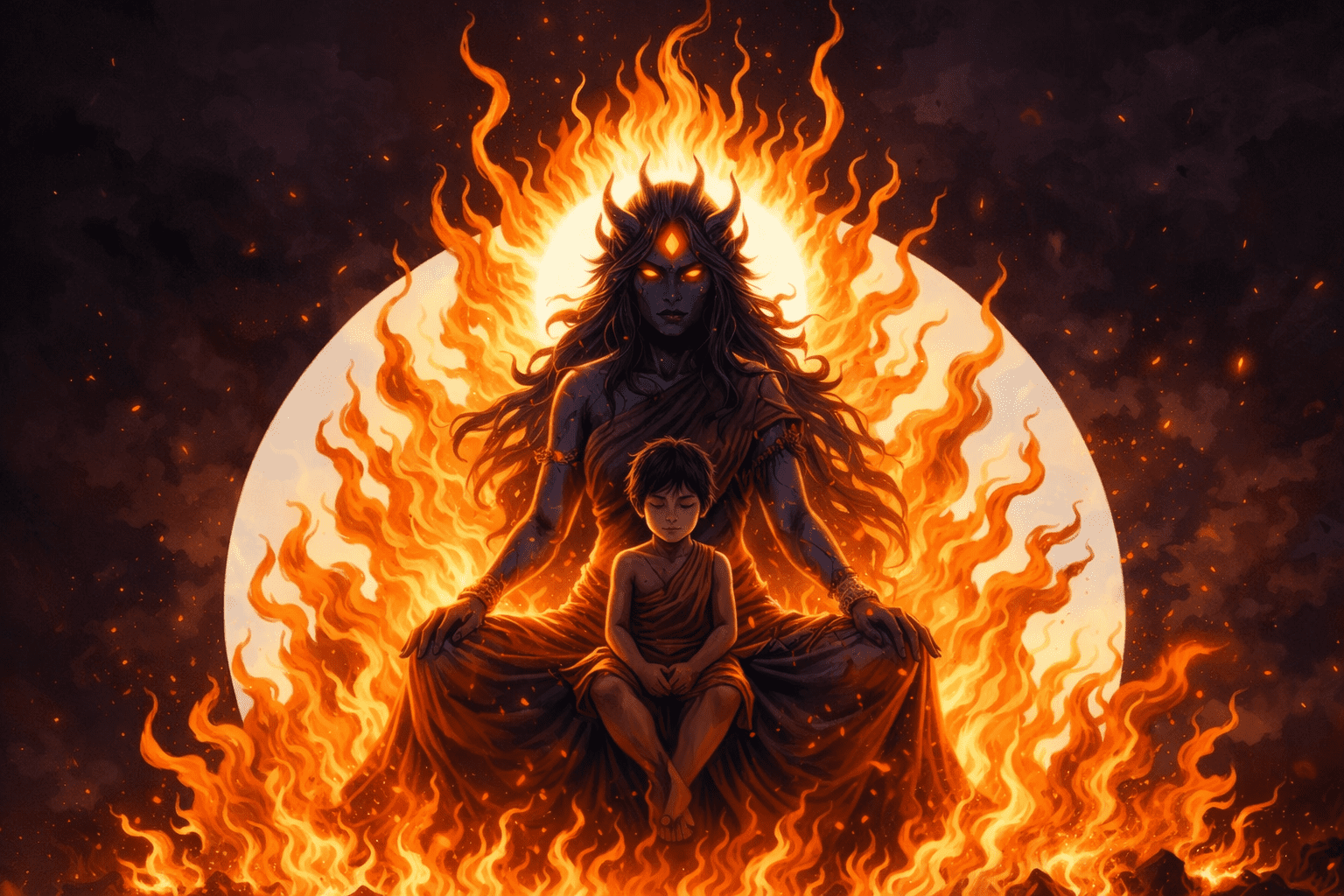
The night seems folded into itself; though the moon hangs in the sky, its light does not dare touch the palace walls. Only the red glow of the ritual fire moves restlessly, casting long, trembling shadows across the ground. It is the sacred night of Holika Dahan, yet inside the palace, it feels less like a festival and more like the eve of destiny. At times the wind drifts in softly, at others it strikes in sudden gusts, feeding the flames so they rise and fall as if some unseen force is breathing through them. In the distance, the sound of drums dissolves into the depth of the night, while the armor of the soldiers standing in the courtyard flashes again and again with reflected firelight. This is not merely a night of punishment—it is a night of waiting, a night where prophecy and arrogance are set to collide.
When Prahlad is brought into the courtyard, there is no fear in his steps. Courtiers whisper among themselves; some lower their eyes, others stare in curiosity. This moment, which later generations would remember as part of the Holika Dahan story, begins not with flames, but with faith. Hiranyakashipu stands beside his throne, rage burning in his eyes more fiercely than the fire itself. “I will say this one last time,” his voice grows heavy, “there is no one but me.” Yet Prahlad looks at him calmly, as if the answer has long been written within him. Holika steps forward slowly, confidence in her stride, a curl of contempt upon her lips. “Fire cannot touch me,” she declares, and at her words the flames seem to flare even brighter.
Around the blazing pit, the wind begins to circle; the flames sometimes shoot straight upward, sometimes twist into spirals. Smoke rises high only to sink back down, as though the sky itself has bent closer to witness what is about to unfold on this fateful night of Holika Dahan. The fire does not burn with a single voice—at times it whispers, at times it roars, and at times it falls into such silence that it feels as though the flames themselves are listening. Light and shadow play across the faces of those watching from a distance, and the stone courtyard slowly grows hotter beneath their feet.
Holika pulls Prahlad onto her lap, confidence still lingering in her eyes. This confrontation between Prahlad and Holika is not merely a test of fire—it is a test of devotion. On Prahlad’s face rests a strange serenity; he closes his eyes and prays silently, his lips moving just enough to be seen. “You still call upon him?” Holika laughs softly, yet within that laugh flickers a brief uncertainty. The flames begin to encircle them, the light growing so intense that every other face around them fades into a blur.
Where Fate Turned Within the Flames – The True Meaning of Holika Dahan
The fire rises.
The sound changes.
The air grows heavy.
For the first time, fear appears in Holika’s eyes; her grip tightens as the flames brush against her garments, yet around Prahlad the fire seems to move differently, almost as if it is dancing away from him. The crackling of splitting wood, the swirling smoke, and the suffocating silence of the onlookers merge into a single frozen frame. Within the flames something seems to stir—not clearly visible, yet the sense of a presence is so powerful that some of the soldiers instinctively step back.
Suddenly, a scream pierces the night.
Then silence again.
The flames slowly begin to lower, and as the smoke clears, everyone sees Prahlad standing unharmed. In this defining moment of Holika Dahan, the fire becomes a witness—burning arrogance but sparing devotion. Holika’s form collapses into ash upon the ground, the wind lifting and scattering it away. No one speaks, yet the silence itself feels as though it is casting a question up toward the heavens.
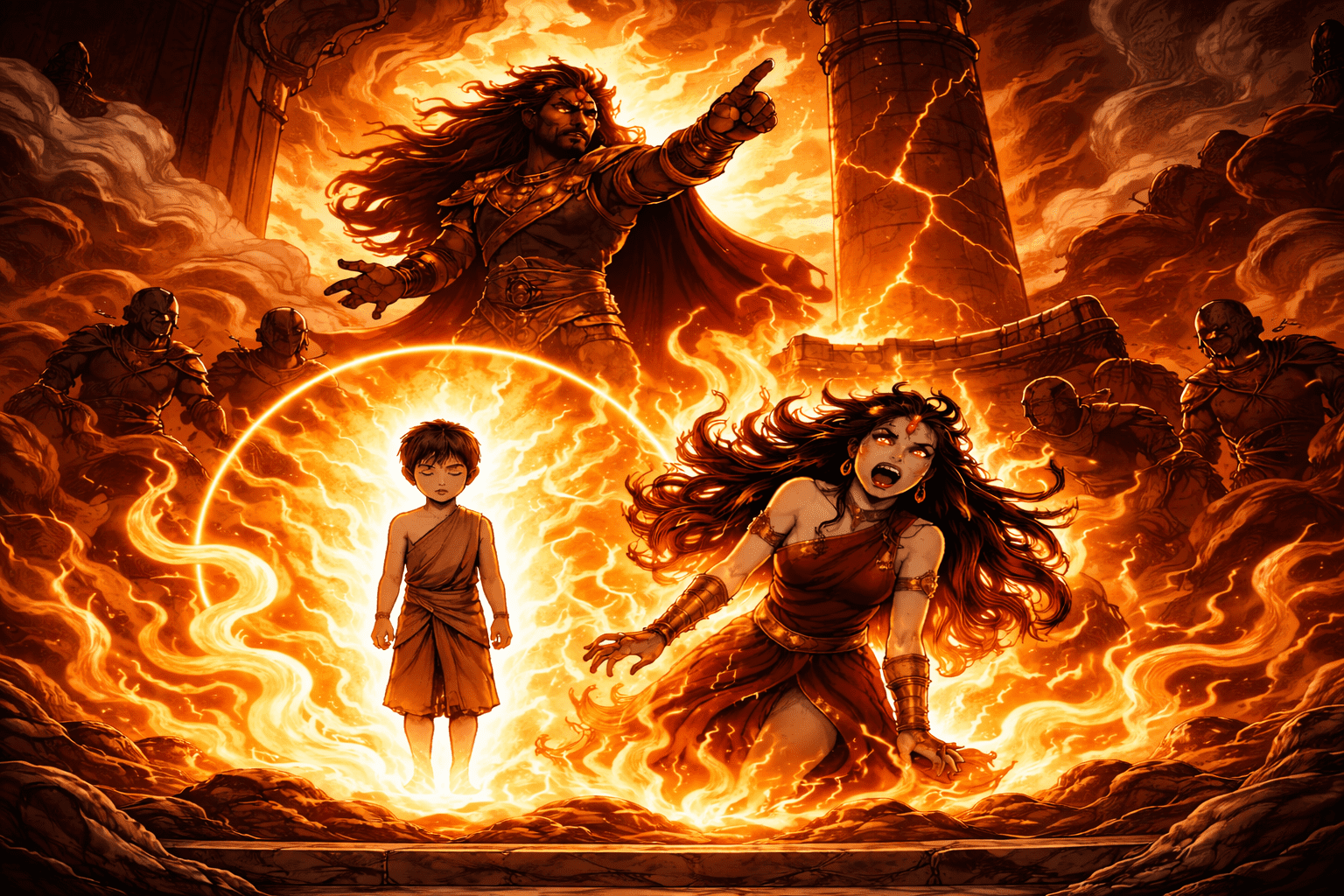
Disbelief hardens across Hiranyakashipu’s face; his breathing grows heavy, anger and fear mixing in his eyes, though he masks that fear with fury. This turning point in the Hiranyakashipu story shakes the very foundation of his pride. “Impossible…” His lips tremble as he steps forward. Prahlad slowly opens his eyes and looks at him, as though he had always known this moment would come. The air has turned cold, yet the heat of the ground still burns, and that lingering warmth seems to intensify the tension all around.
“Where is your God?” Hiranyakashipu roars, raising his hand and pointing toward the massive pillar. His voice echoes back from the palace walls. In a calm voice, Prahlad replies, “He is everywhere.” At that answer, Hiranyakashipu’s laughter grows darker. “In this pillar?” He strides forward and strikes the stone with his fist. The pillar trembles, dust falls from above, and for a brief moment, the air itself seems to stop.
The Demon’s Laughter and the Silence Before Fate Strikes
An uncanny silence suddenly descends inside the palace; the wind stops, the flames freeze in place, as if time itself is holding its breath. Torchlight trembles and casts long, wavering shadows, and every eye turns in the same direction—toward the pillar. Somewhere in the distance, a metallic clang falls, but it sounds like a memory from far away.
Prahlad slowly steps back, no astonishment in his eyes, only expectation. Hiranyakashipu strikes again, harder this time. Cracks spread through the stone, and from deep within those fractures comes a strange sound—neither human nor beast, yet somehow both.
The sound comes again.
Louder.
The stone trembles.
Soldiers retreat instinctively. Dust rises and spirals through the air. The light fractures strangely, as though even the fire has grown afraid. The crack widens further, and within it the darkness shifts. Now the roar is unmistakable—so deep that the ground itself shudders.
Hiranyakashipu stands unmoving, disbelief and fury burning in his eyes. “Who is there?” he roars, but the only answer is another thunderous roar that shakes the entire palace to its core.
The Rise of Narasimha Avatar: When Time Itself Was Rewritten
The crack shatters in an instant; stone bursts apart, dust and fire swirl together in the air, and from within that chaos rises a terrifying form—half man, half lion. It is the awe-inspiring Narasimha avatar, the divine answer to arrogance. The reflection of flames burns in his eyes, his golden mane whipping through the air, and with a single roar the very ceiling of the palace trembles. Time itself seems to freeze.
Hiranyakashipu does not retreat. He raises his weapon and lunges forward with a furious cry. But Narasimha moves like a storm—one strike, then another in swift succession. The crash of breaking stone, the thunder of roars, the clash of metal—together they form a dreadful symphony. The steps of the throne splinter, fire scatters across the hall, yet amid the chaos Narasimha’s gaze never wavers.
At the threshold—neither inside nor outside—at the precise edge of twilight, Narasimha seizes Hiranyakashipu. The moment stretches unbearably long; the air stands still, all sound falls away, save for the echo of that primal roar circling through the hall. Then, with the speed of lightning, the final blow descends—arrogance collapses, and time is rewritten.
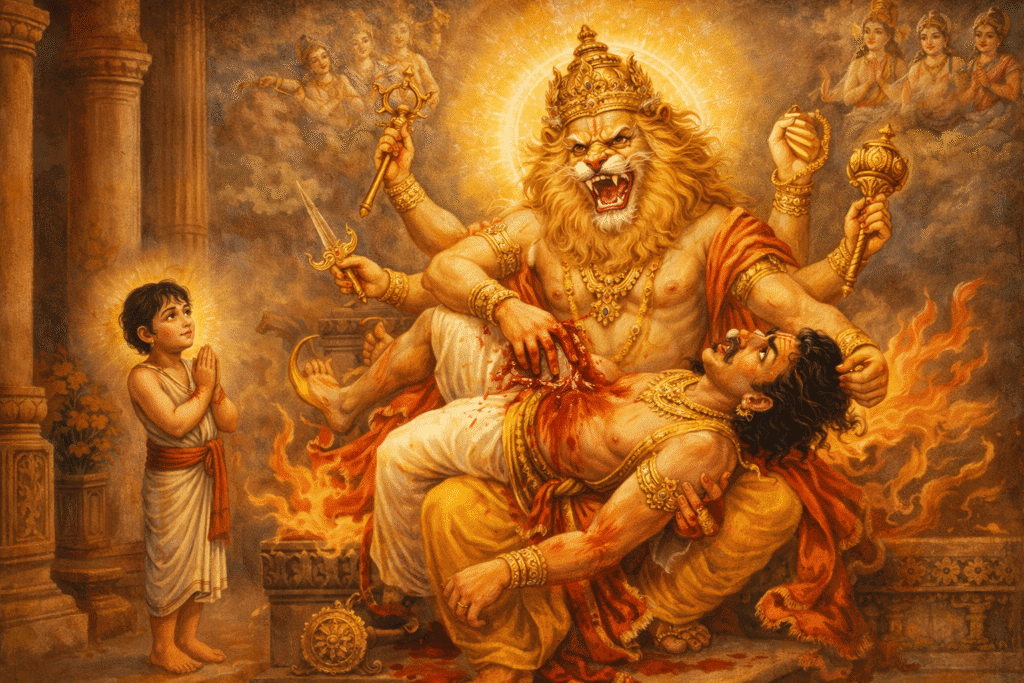
Everything stops. The fire slowly begins to subside, smoke rising and dissolving into the air. The soldiers can no longer stand; they fall to their knees. Prahlad steps forward quietly, no fear in his eyes, only deep reverence. Narasimha’s breath is heavy, yet within that fury an unfamiliar calm begins to return.
“Father…” Prahlad says softly, and even the air seems to soften. The hardness in Narasimha’s eyes fades; his roar diminishes into a slow breath. Along the palace walls, the glow of the flames grows gentle now, as though the storm has finally passed.
Night slowly yields to dawn; the color of the sky begins to change, and where fire once raged, only ash now remains, the wind lifting it gently before letting it fall again. Broken pillars, a shattered throne, and a silent palace stand as though at the end of the Holika Dahan story.
Prahlad stands alone, gazing up at the sky, silence surrounding him—yet within that silence, the promise of a new beginning quietly stirs. The deeper spiritual meaning of the festival of Holika Dahan lives on: faith survives, arrogance burns, and divine justice prevails.
The wind moves softly.
Ash rises, then settles once more.
No one speaks.
And yet, it feels as though everything has already been said.